

Does Makeup Make A Women More Comfortable ?
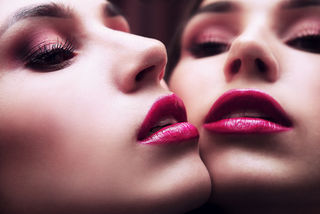
Source: Kuznechik/Shutterstock
Celebrities are challenging standard notions of beauty by embracing the No-Makeup Await. But how does this tendency impact adult female generally?
For decades, if not centuries, women take worn makeup to achieve a cultural standard of beauty. Cosmetics are used strategically to enhance certain features and hide others. From an evolutionary perspective, the qualities nosotros consider beautiful are related to signals of reproductive fettle, such as sexuality, health, and youthfulness. Makeup that gives women red lips, flawless pare, captivating eyes, and a flake of blush all increment attractiveness, at least from a biological and cultural standpoint.
Research shows that makeup tin can significantly modify the impression we have of women. Nash and colleagues (2006) conducted a study in which both men and women rated either pictures of women without makeup, or the aforementioned women with makeup. Women presented wearing cosmetics were perceived as healthier and more confident than when presented without makeup. Participants in the study as well credited women wearing makeup with a greater earning potential and with more than prestigious jobs than the same women without cosmetics. Moderate makeup use is likewise linked to assumptions of wellness, heterosexuality, and brownie in the workplace (Dellinger & Williams, 1997).
Clearly, in that location are strong incentives for women to wear makeup in the workplace. Socially, makeup not only increases perceived attractiveness, but information technology can also increase women's confidence. If women believe that wearing makeup increases their attractiveness, then it'southward easy to encounter why they may feel meliorate wearing it. Outward appearance can have a powerful influence on self-esteem. A report on the state of self-esteem by the Pigeon Self-Esteem Fund (2008) stated that "78 percent of girls with low self-esteem admit that it's hard to feel skilful in schoolhouse when y'all don't feel good well-nigh how you look (compared to 54 percent of girls with high self-esteem)."
Many women do experience less confident when they don't wear makeup. Alexis Sclamberg (2012) reported on a survey conducted by the Renfrew Centre, which institute that 44 percent of women felt more unattractive and uncomfortable when they didn't article of clothing makeup than when they did: 16 percent reported feeling unattractive; 14 percent reported feeling self-conscious; and 14 per centum reported feeling naked without makeup (Renfrew Center Foundation, 2012). This study too plant that only 3 percent of women reported that going without makeup fabricated them feel more bonny.
Yet, information technology's non articulate that wearing makeup is entirely beneficial. A study by Robertson and colleagues (2008) constitute a positive correlation betwixt frequent use of cosmetics and anxiety, cocky-consciousness, and conformity. Women who reported wearing makeup less frequently tended to accept higher social confidence, emotional stability, and self-esteem.
In another written report, women who were concerned about their appearance wore more makeup and were more apt to believe that makeup enhanced their social interactions. The researchers reasoned that this could be a cocky-fulfilling prophecy: Women who are more than cocky-conscious wear more than makeup, and judge themselves to exist more attractive when wearing makeup, so they might act more confidently and the people they interact with may respond to that confidence in a more positive way (Miller and Cox, 1982).
It's clear that women relish advantages to wearing makeup. It can increment their perceived attractiveness, give them more conviction, and create a favorable impression in piece of work and social settings.
Then why is the no-makeup trend gaining popularity?

Source: Federico Marsicano/Shutterstock
The No-Makeup Look appears to have been adopted past women who are comfortable with themselves and their appearance. By embracing this trend, these women may be sending a bulletin that they desire to be seen more than authentically — to be accepted for how they actually expect, without camouflage or enhancements.
In a preliminary study, women looked at their own reflection in a mirror every day with no goal other than to stay nowadays with themselves. After a two-week period, they reported being more comfortable with their appearance and less concerned with wearing makeup; they also reported a subtract in stress and an increase in self-pity (Well, et al. 2016).
If y'all're intrigued by the no-makeup look, simply not ready to go to work or out on a date without it, attempt this experiment as part of your morning routine: Sit in front of a mirror for x minutes without makeup and simply look at yourself — with no goal other than to stay present with yourself. Exist aware of your thoughts and feelings as yous look at yourself, and see if y'all tin let go of any critical voices and view yourself with a bit of pity. Do this regularly for 10 minutes a day for at least 2 weeks and see what happens.
Let me know about your feel, reactions, and questions about this commodity on our Mirror Meditation Community Folio. You'll too find more manufactures on meditation, cocky-sensation and cocky-compassion there. You can also sign-upwardly for the vii-mean solar day Mirror Meditation Challenge, and become 7 daily lessons delivered to your inbox.
Observe out more than about the exercise of Mirror Meditation at The Clear Mirror. Follow on me Twitter and Instagram for daily updates and inspiration.
References
Davis, C., Dionne, G., & Shuster, B. (2000). Physical and psychological correlates of appearance orientation. Personality and Individual Differences, 30 (2001), 21-30.
Dellinger, K., & Williams, C. 50. (1997). Makeup at work: Negotiating appearance rules in the workplace. Gender & Social club, 11(2), 151-177.
Dove, Strategy One, and Ann Kearney-Melt. (2008, June). "Real Girls, Real Pressure: A National Report on the Country of Cocky-Esteem Commissioned: June 2008." The Dove Self-Esteem Fund. Pigeon.com, Web.
Etcoff, North. L., et al. (2011). Cosmetics equally a Feature of the Extended Man Phenotype: Modulation of the Perception of Biologically Important Facial Signals. PLOS. Web.
Miller, L. C., & Cox, L. C. (1982). For Appearances' Sake: Public Self-Consciousness and Makeup Usage. Personality and Social Psychology Bulletin 8. 748-751.
Nash, R., Fieldman, K., Hussey, T., Lévêque, J., & Pineau, P. (2006). Cosmetics: They Influence More than Than Caucasian Female Facial Bewitchery. Journal of Applied Social Psychology, 36(two), 493-504.
Renfrew Eye Foundation (2012, Feb, 22). New Survey Results Signal There's More to Makeup Use Than Meets the Middle. Renfrew Middle Foundation. Web.
Robertson, J., Fieldman, G., & Hussey, T. (2008). Who wears Cosmetics? Individual Differences and their Relationship with Cosmetic Usage. Individual Differences Inquiry, half-dozen, 38-forty.
Sclamberg, Alexis. "Makeup: Could You Go a Day Without Information technology?" The Huffington Post. TheHuffingtonPost.com, 21 February. 2012. Web.
Theberge, L., & Kernaleguen, A. (1979). Importance of cosmetics related to aspects of the cocky. Perceptual and Motor Skills, 48, 827-830.
Well, T., et al. (2016). The Benefits of Mirror Meditation. Paper presented at the American Psychological Clan Convention in Denver, CO.
Source: https://www.psychologytoday.com/us/blog/the-clarity/201707/why-more-women-are-happily-going-without-makeup
Posted by: stokeswharroposs.blogspot.com
0 Response to "Does Makeup Make A Women More Comfortable ?"
Post a Comment